Decode
Work through an unfamiliar MCAT-style passage before you see a single answer choice: hypothesis, independent and dependent variables, control, manipulation, what the graph shows, and more.
Try Decode →Scientific reasoning training for the MCAT
Most MCAT prep drills content. This drills the reasoning skill AAMC scores separately — reading data, spotting variables, and knowing what a result actually proves.
Three ways to train
Work through an unfamiliar MCAT-style passage before you see a single answer choice: hypothesis, independent and dependent variables, control, manipulation, what the graph shows, and more.
Try Decode →Identify the IV, find the control, predict the direction, spot the confounder. Rapid-fire drills for the skills the MCAT keeps testing. Train one reasoning skill at a time until the right move becomes automatic under pressure.
Timed skill-based repsFind exactly why you made that mistake — the specific reasoning step that broke down, not just a vague label like “experimental reasoning error.” Instead, pinpoint the breakdown: Experimental reasoning → causal inference → interpreted correlation as causation.
Granular mistake review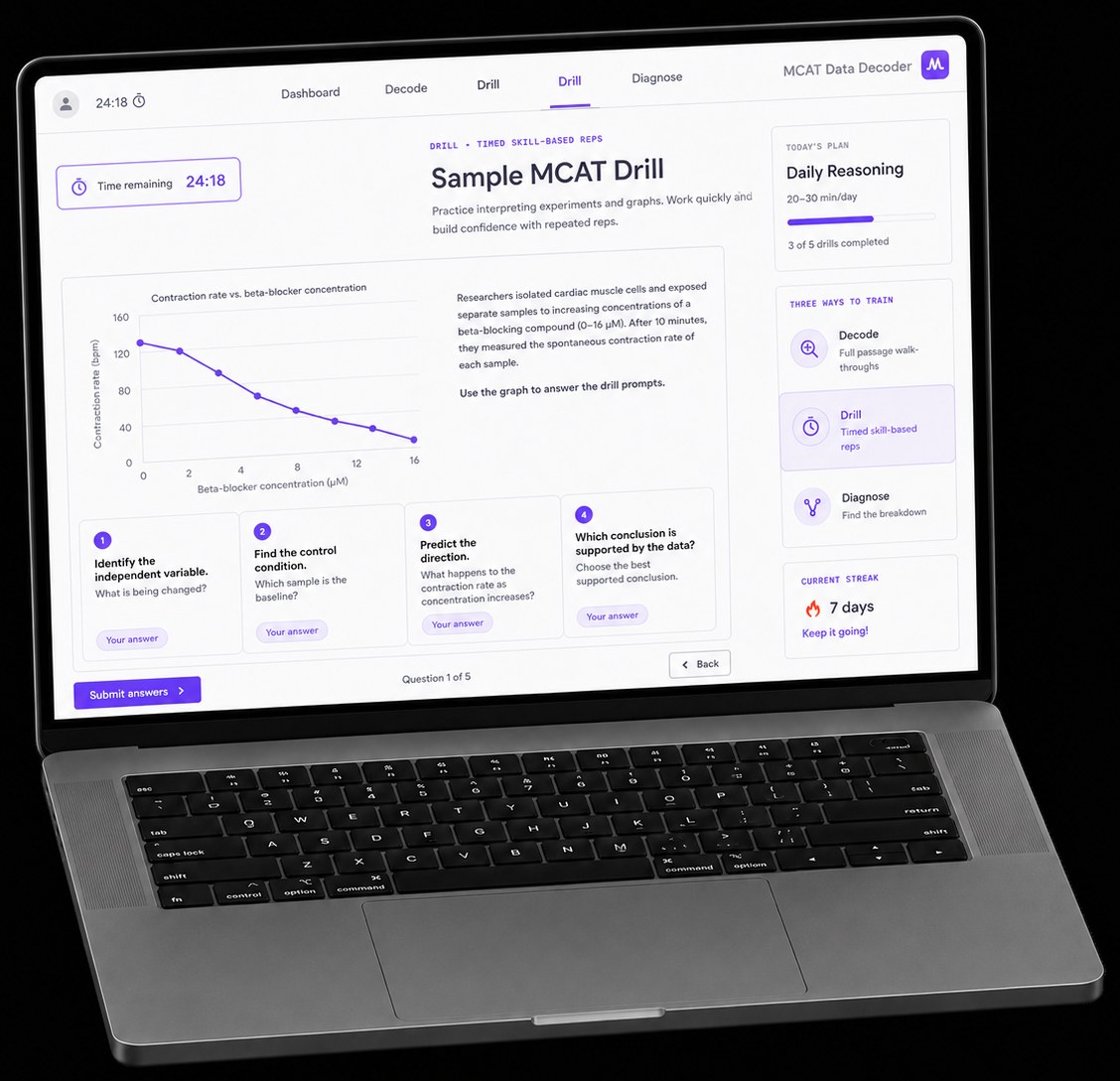
Where this fits in your prep
This isn’t a replacement for your question bank — it’s a complement. Spend 10–20 minutes a day on graphs, experiments, and data interpretation to strengthen the reasoning those questions depend on.
No need to finish content review first. Start from day one of your prep, run it alongside your regular practice, and the underlying skills are already built by the time you hit full MCAT passages.
See exactly where you stand
Not “Biochem: 72%.” A per-skill readout that separates content knowledge from the reasoning skills AAMC tests on top of it — so a strength in one doesn’t hide a gap in the other.
Illustrative example — your fingerprint starts building from your very first drill
Try it — sample MCAT drill
Researchers measured the initial reaction velocity of an enzyme across increasing substrate concentrations (0–32 mM), first with no inhibitor present and then again with a candidate inhibitor drug added, using the same enzyme concentration and reaction conditions both times.
That’s Diagnose, on one drill. Do this every time and your reasoning gaps start showing up as a pattern.